MATCH REVIEW · PART 2
Waiting for price,switching marketsand managing risk.
How the pre-match thesis was executed live.
Waiting for price, switching markets and managing risk at the end.
Winning is the result. Price reflects the quality of the decision.
7–0
RECORD
4.50
STAKED
+3.1995
PROFIT
+71.10%
ROI
Part 1 explained why Celtic's expected advantage was expressed through the corner markets rather than the score handicap, and laid out the live-entry conditions we had fixed in advance. Part 2 covers how that plan was actually executed, and how the match finished.
Two corners in three minutes — and still no chase
Celtic won two corners inside the first three minutes. Taken in isolation, that looks like a simple signal: two corners already, so buy the over.
What we actually did was the opposite. We already knew from pre-match data and past fixtures that Celtic's corner potential was high — that was exactly why we had already taken two pre-match corner positions. The early two corners simply confirmed the pre-match thesis; they were not new information that changed our live plan.
They were, however, a clear overheating signal for the live market. Two corners this early shortens the over price, raises the line, increases the required count, and lowers the expected value of the same underlying view. The direction was right from the opening minutes, but being right about direction is not the same as buying at the right price — so we did not add immediately.
Waiting for price, not for more corners
Our pre-set entry condition was straightforward: wait for corners to pause temporarily after the early burst, provided Celtic's territorial structure stayed intact, then enter once the line or odds recovered to a buyable level. We were not waiting for the corner count to keep climbing — we were waiting for a temporary lull to bring the price back.
28 minutes: the price we were waiting for arrived
By the 28th minute Celtic had two first-half corners, with two more needed before the break. At this point, 1H Celtic Team Corners Over 3.5 had drifted out to 1.89.
1H Celtic Team Corners O3.5 @1.89
- Odds taken: 1.89
- Required probability: 52.9%
- Estimated probability: 57–63%
- Fair odds: 1.59–1.75
- Edge: +4.1 to +10.1 points
- EV: +7.7% to +19.1%
We checked more than the raw corner count before entering: the score was still 0-0, Celtic retained control, the wide attacks continued, Dundee remained deep, and roughly 17 minutes of the first half remained — all pointing to Celtic sustaining attacking intensity until they scored.
This was not a bet made by chasing the opening two corners. It was a bet made by passing when the market overheated, waiting for the price to recover, and confirming the underlying structure was still intact before entering. Celtic won their fourth corner soon after. But the quick result was not the point — the discipline of recognising a high-potential market while refusing a bad price, and waiting for the price to move, was what this live bet was really about.
Halftime: 0-0, but the pre-match thesis held
The first half ended 0-0. Celtic had not scored. The underlying data, however, told a different story.
| Halftime metric | Celtic | Dundee |
|---|---|---|
| xG | 1.42 | 0.31 |
| Attacks | 60 | 36 |
| Dangerous attacks | 49 | 24 |
| Corners | 6 | 3 |
| Pass accuracy | 86% | 71% |
| Crosses | 9 | 3 |
Celtic were clearly ahead on attacking volume, dangerous attacks and corners. The score was 0-0, but the shape of the match — sustained Celtic pressure without a proportional number of goals — matched exactly what we had modelled pre-match. First-half corners finished 6-3, which settled both the pre-match -2.5 handicap and the 28th-minute Over 3.5.
Different half, different market
Nine total corners by halftime did not mean the same pace would continue after the break. If anything, we expected the second half to produce fewer corners. In a 0-0 first half, Celtic had every reason to keep pressing until they scored. Once Celtic took the lead in the second half, the game state would change: Celtic could manage the match and reduce attacking risk, Dundee would likely push higher, and Celtic would spend less time pinned in the attacking third. So instead of adding to the corner overs at halftime, we shifted into the result and goal markets.
HT: Celtic Win × Total Under 3.5 @1.63
Even at 0-0, we still rated Celtic's win probability highly. At the same time, the probability of four or more goals in the remaining 45 minutes had fallen relative to kickoff. Combining Celtic Win with Total Under 3.5 captured both views.
- Odds taken: 1.63
- Required probability: 61.3%
- Estimated probability: 65–69%
- Fair odds: 1.45–1.54
- Edge: +3.7 to +7.7 points
- EV: +6.0% to +12.5%
The central scoreline scenarios were 1-0, 2-0, 2-1 and 3-0. Celtic to win alone offered too little price, but adding Under 3.5 — supported by the 0-0 first half — lifted the combined odds to 1.63 without materially weakening the win scenario.
HT: Celtic First Goal & Win @1.48
The second halftime selection was Celtic to score first and go on to win.
- Odds taken: 1.48
- Required probability: 67.6%
- Estimated probability: 70–73%
- Fair odds: 1.37–1.43
- Edge: +2.4 to +5.4 points
- EV: +3.6% to +8.0%
These are not two independent conditions multiplied together. Once Celtic score first, their probability of going on to win rises sharply — the two outcomes are strongly positively correlated. Given the first-half xG, attack volume, dangerous attacks and corner tallies, Celtic scoring before Dundee looked more likely than not, and doing so would put them in position to manage the game to victory. The EV here was smaller, so we sized it below the primary bet, but it was well aligned with what the first half had shown.
No entry right after the restart
We did not immediately add Celtic First Goal when the second half began. Celtic scoring first still looked probable, but adding at a low price offered little value. So we waited — watching whether Celtic maintained their pressure, whether the first-half structure held, whether Dundee adjusted, and whether the price would improve as time passed. A few minutes in, with Celtic still clearly in control, the first-goal price drifted out to around 1.50, and we entered.
Celtic First Goal @1.50
- Odds taken: ≈1.50
- Required probability: ≈66.7%
- Estimated probability: 71–75%
- Fair odds: 1.33–1.41
- Edge: ≈+4.3 to +8.3 points
- EV: ≈+6.5% to +12.5%
At 1.50: an estimated 71% gives 0.71 × 1.50 − 1 = +6.5%; 73% gives +9.5%; 75% gives +12.5%. The point again was not "Celtic look like they'll score, so buy it" — it was rating the first-goal probability highly while waiting for the price to fall to a required probability of roughly 66.7% before entering. Celtic scored shortly after, putting both the halftime First Goal & Win and the second-half First Goal bet on track.
After the opener, we did not add in the same direction
Once Celtic led 1-0, backing the next goal to be Celtic's again was an available option. But by this point our live book was already heavily tilted toward Celtic: Celtic Win × Under 3.5, Celtic First Goal & Win, and Celtic First Goal.
Celtic scoring again looked likely. But in a 1-0 match, a single mistake or set piece can turn it into 1-1 — and a 1-1 scoreline would simultaneously break both the Celtic Win × Under 3.5 and First Goal & Win positions. Adding more exposure in the same direction would mean a single bad event could unwind several bets at once. So at minute 65, we added a position designed to preserve the winning scenarios while thinning out the losing ones.
65 minutes: Dundee +2.5 × Total Corners Under 15.5 @1.899
- Odds taken: 1.899
- Required probability: 52.7%
- Estimated probability: 58–62%
- Fair odds: 1.61–1.72
- Edge: +5.3 to +9.3 points
- EV: +10.1% to +17.7%
This bet was not a prediction that Dundee would equalise. It kept the Celtic-win thesis as the primary view while covering a wider range of live scorelines: 1-0, 1-1, 2-0, 2-1 and 3-1.
Why +2.5 rather than +1.5
Dundee +1.5 would lose the moment Celtic extended the lead to 2-0 — and a second Celtic goal looked entirely plausible. So instead of a handicap that ruled out a further Celtic goal, we chose +2.5, which survives a 2-0 scoreline as well. The line accounted for the realistic chance of another Celtic goal while still requiring an appropriate price to enter.
At +2.5, the bet wins under 1-0, 1-1, 2-0, 2-1 and 3-1. In short: a further Celtic goal was plausible, but the match extending beyond a two-goal swing from there was not. This was not a contrarian bet against Celtic — it was a partial hedge designed to offset losses in the scenarios where the win-side positions would otherwise fail.
Why we combined it with Total Corners Under 15.5
At halftime, corners already stood at 6-3, nine in total. But we had expected the second-half pace to slow even before kickoff. In a 0-0 first half, Celtic needed to keep pressing until they scored. Once Celtic took the lead, the game state changed: Celtic no longer needed to maximise attacking volume, and if Dundee pushed higher, Celtic would spend less time pinned in the final third.
So we judged the probability of total corners reaching 16 or more from the 65th minute onward as lower than the market implied. The final corner count was 9-3, twelve in total. We bought the over in the first half and switched to the under after the opener — the same corner market, but a different expected direction depending on time and score.
Why we passed on cards
The match finished with zero cards. Celtic at Celtic Park, when controlling long spells of possession, tend not to attract many cards. But that alone is not a reason to buy an under purely off Celtic's average card count.
What actually matters is the opponent's defensive method, foul counts, how often counters need stopping, midfield duels, the referee's tendencies, match intensity, and live physical engagement. Dundee chose to defend through blocks and clearances rather than rough tackling, and Celtic's attacks were more often stopped by blocked shots and crosses — converted into corners — than by fouls.
The result was zero cards, and there was a case for the under. We did not actually place this bet, so it is not counted as a real position here — it is recorded as a learning log entry for future live judgement.
Final result
FULL TIME
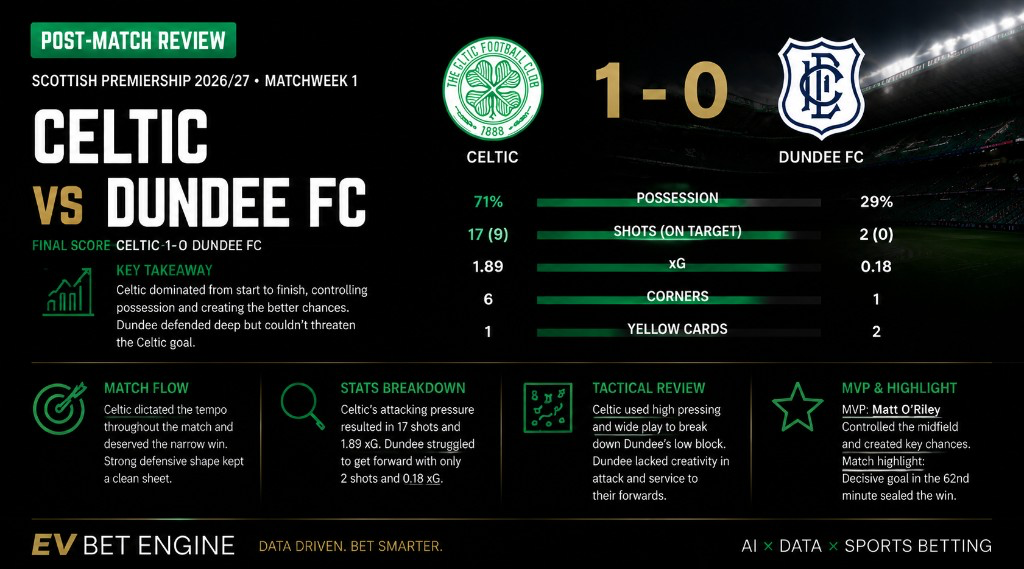
Celtic 1-0 Dundee FC
First half 0-0 | First-half corners 6-3 | Final corners 9-3 | Cards 0-0
Full bet log
| Entry | Market | Odds | Result |
|---|---|---|---|
| Pre | 1H Celtic Corners Handicap -2.5 | 1.95 | Win |
| Pre | Celtic Corners -4.5 × Total Corners O10.5 | 2.37 | Win |
| 28′ | 1H Celtic Team Corners O3.5 | 1.89 | Win |
| HT | Celtic Win × Total U3.5 | 1.63 | Win |
| HT | Celtic First Goal & Win | 1.48 | Win |
| 2H restart | Celtic First Goal | ≈1.50 | Win |
| 65′ | Dundee +2.5 × Total Corners U15.5 | 1.899 | Win |
4.50
TOTAL STAKED
+3.1995
TOTAL PROFIT
+71.10%
ROI
What mattered more than seven wins from seven
All seven bets that were actually placed won. But treating this as simply "a match where everything hit" would erase what actually mattered:
- Celtic's advantage was translated into corners, not a score margin. Celtic pressing the match and Celtic winning by a wide margin were treated as two separate probabilities.
- We did not chase the over after two corners in three minutes. The more accurate the pre-match read, the faster the market re-prices — being right about direction is not enough if the price is wrong.
- The entry price was decided in advance, anticipating a temporary lull. A pause in corners was treated as a pricing opportunity, not a failed thesis.
- The 28-minute entry combined structure and price, not just the count. We weighed remaining time, match structure, the corners still required and the odds together — not simply "three corners already happened."
- The market was switched at halftime. Rather than mechanically chasing another corner over, we shifted into result and goal markets once a slower second-half pace was expected.
- We passed on the cheap First Goal price right after the restart. We rated Celtic's first-goal probability highly but waited for the price to drift to roughly 1.50.
- We did not pile further into the same direction after the opener. Dundee +2.5 allowed for a further Celtic goal while trimming the downside if the score turned 1-1.
Recording the decisions, not just the results
A sports-betting article can simply list results: this bet won, that bet won, everything hit. But that alone cannot be reproduced. What matters is documenting what was predicted, why that market was chosen, which markets were passed on, what price triggered an entry, what the market's required probability was, what our estimated probability was, how large the edge was, what changed during the match, and why positions were adjusted.
Describing the 28-minute bet as "two corners came in three minutes, so we bought the over" would misrepresent what actually happened. The accurate version is: we already rated Celtic's corner potential highly before kickoff; the early two corners overheated the market, so we did not buy in the moment; we had a pre-set entry price for a temporary lull and waited; and at 28 minutes, with the line at 3.5 and odds at 1.89, and the underlying structure still intact, we entered. That level of detail is what gives the write-up any lasting value.
Summary
What we actually bought this match was never simply "Celtic blowout." It was the recurring match structure at Celtic Park: Celtic press for long spells, the scoreline does not always follow at the same rate, and blocks and clearances keep converting into corners. We bought that structure through the corner markets in the first half, then switched into the result and goal markets once the halftime data confirmed the thesis. After Celtic's opener, rather than chasing another goal, we adjusted the book with Dundee +2.5 and a corners under.
An expected blowout does not have to mean buying the score margin. The question is which number that advantage shows up in most reliably — and beyond just being right, waiting for a good price, comparing required probability against estimated probability, switching markets when the game state changes, and trimming risk when a book becomes one-sided while still protecting the winning scenario.
Celtic's season opener turned out to be a single match where EV Bet Engine's pre-match modelling and live execution came together exactly as intended.
DATA DRIVEN. BET SMARTER.
The original Japanese article is also published on note.
Read on note